


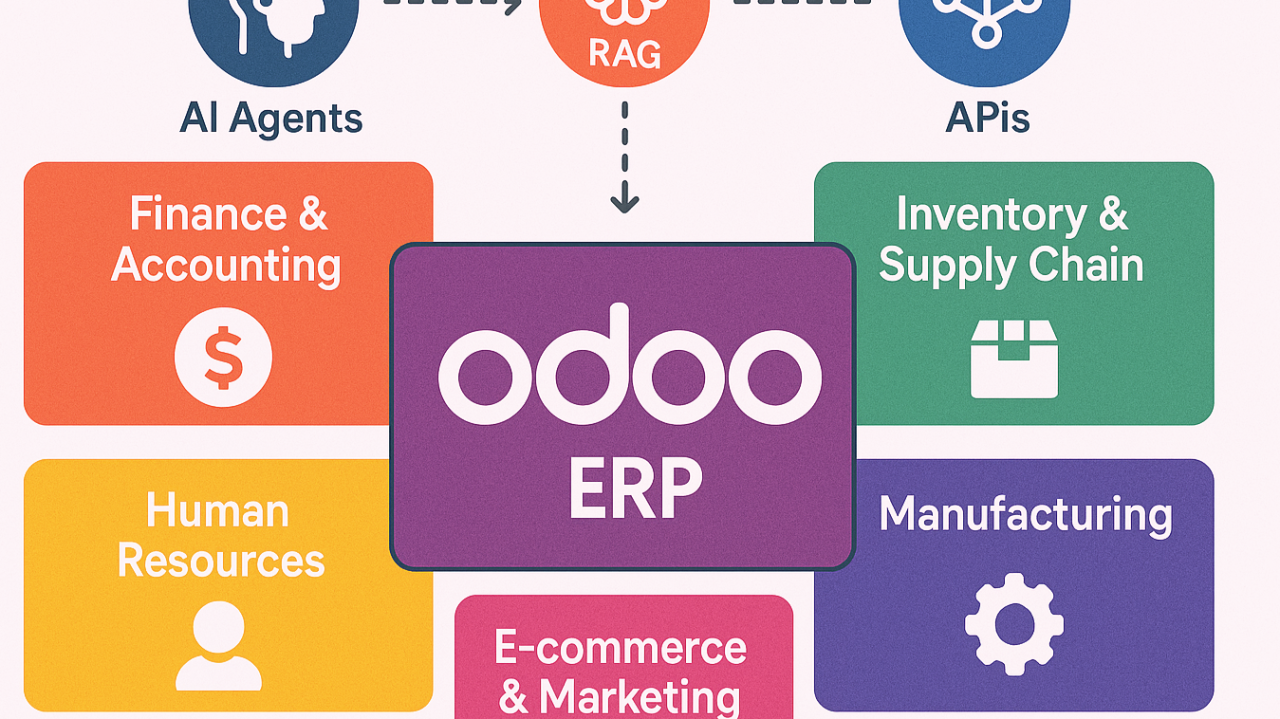
Unlocking Enterprise Value with AI-Powered Integrations
In today’s digital economy, businesses can’t afford to run on disconnected systems. Finance, supply chain, sales, and customer engagement must operate seamlessly, sharing information in real-time. That’s why Enterprise Resource Planning (ERP) systems are the backbone of modern organizations.
With over 28 years of experience in ERP, I have witnessed how major ERP platforms such as SAP, PeopleSoft, Oracle, Microsoft Dynamics, Workday, Odoo and others have evolved and competed for market share.
In the age of AI, traditional ERPs are striving to automate key business processes, yet many major platforms face challenges due to their complex legacy technologies. It’s only a matter of time before new, lighter AI-driven ERP solutions emerge and disrupt the market. Until then, incumbents are in survival mode — and disruption could quickly turn that into panic mode.
Among today’s ERP solutions, Odoo stands out because of its modular design, open architecture, and cost-effective approach — making it far more adaptable than many of the traditional, monolithic systems. I often use Odoo as an example to showcase where and how AI adoption can deliver real business value. What makes Odoo truly future-ready is its flexibility to seamlessly integrate with advanced technologies. By combining it with Artificial Intelligence — through agentic AI models, Retrieval-Augmented Generation (RAG), and RESTful APIs — organizations can build smart, adaptive integrations that go beyond automation. This opens the door to intelligent workflows, predictive decision-making, and AI-driven user experiences that can fundamentally transform how enterprises operate, scale, and compete in the digital era.
Odoo’s modular framework allows organizations to start small and expand as needs grow. Here’s a closer look at the core modules and how they drive business value:
Finance & Accounting
Core Functions: General ledger, invoicing, payments, reconciliations, expense tracking.
AI Potential: Automated invoice recognition, anomaly detection in transactions, predictive cash flow forecasts, and AI-driven audit checks.
Sales & CRM
Core Functions: Lead management, quotation, order processing, contract management.
- AI Potential: AI-powered lead scoring, natural language summarization of sales opportunities, automated proposal generation, and customer sentiment analysis.
Inventory & Supply Chain
Core Functions: Warehouse management, stock tracking, purchase orders, shipping coordination.
- AI Potential: Demand forecasting using predictive analytics, AI agents that re-route logistics based on delays, and automated reorder triggers via RESTful integrations.
Human Resources (HRM)
Core Functions: Recruitment, onboarding, payroll, performance management.
- AI Potential: AI chatbots for recruitment screening, AI agents for employee sentiment tracking, automated compliance reporting, and smart learning recommendations.
E-commerce & Marketing
Core Functions: Online store management, campaigns, customer engagement.
- AI Potential: Personalized product recommendations, AI-generated marketing content, predictive campaign ROI analysis, and automated social media publishing.
How AI Elevates Odoo’s Impact
The integration of AI + Odoo isn’t about replacing human decision-making; it’s about augmenting it. Let’s break down how AI agents, RAG, and APIs enhance ERP functions across the board:
Natural Language Interfaces
Instead of navigating menus and reports, users can ask: “Show me overdue invoices over €10,000” or “What’s the forecasted demand for Product X in Q4?” AI retrieves, interprets, and presents ERP data instantly.
Process Automation with Agentic AI
Agentic AI can take actions across systems, not just provide insights.
- Example: If sales orders exceed stock, the AI agent triggers a purchase order in Odoo and notifies suppliers via REST API.
- Example: When HR records show employee attrition risk, AI initiates a retention workflow.
RAG for Knowledge-Driven Decisions
ERP data is often complex and siloed. With retrieval-augmented generation (RAG), AI combines Odoo data with external knowledge sources to produce richer answers.
- Example: Finance managers get not just a P&L snapshot, but AI-generated commentary comparing performance to industry benchmarks.
Smart Integrations via RESTful APIs
AI makes Odoo more adaptable by automating integrations with external platforms:
- CRM tools like HubSpot or Salesforce.
- Payment gateways like Stripe or PayPal.
- Logistics providers like FedEx or DHL.
- Business Intelligence tools like Power BI.
- AI agents ensure data flows correctly, flag mismatches, and maintain compliance without manual oversight.
Predictive & Prescriptive Insights
AI doesn’t just report what happened — it tells you what’s likely to happen next and what to do about it.
- Predict demand shifts in supply chain.
- Recommend optimal price adjustments.
- Suggest corrective actions when project costs deviate from budget.
ERP systems have always been about integration and efficiency. With Odoo’s flexible modules and AI-driven integrations, businesses gain a living, evolving system that not only runs operations but also helps predict, adapt, and lead in competitive markets.
